

We built an easily portable mobile model eye, inserted various IOLs into it, and filmed distant buildings during the day and at night, as well as roads at night. For quantitative analysis, we recorded videos of an optotype while approaching it from six meters away.
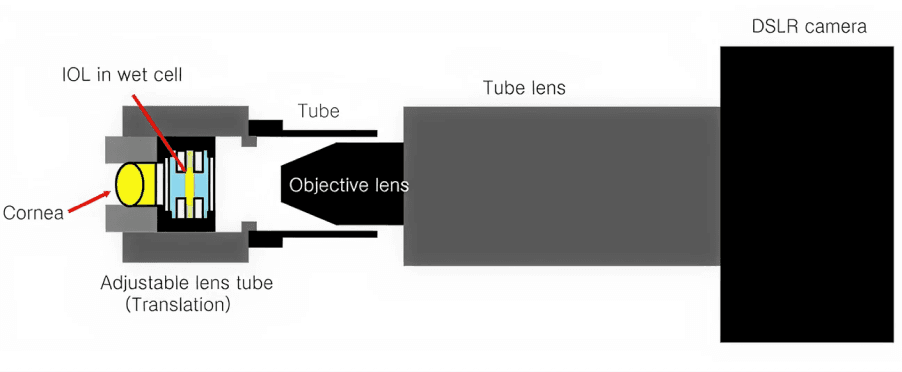
The mobile model eye consists of a lens acting as the cornea, a water chamber, an IOL, and a microscope. By placing IOLs actually used in patients into the water chamber and filming, we examined how patients actually see. Details are described in Prof. Ho Sik Hwang's papers below.
The new portable model eye. It consists of an artificial cornea (an achromatic convex lens), an IOL, a small water chamber, a distance-adjustable tube, an objective lens (x10), a tube lens (focal length 180 mm), and a digital camera.
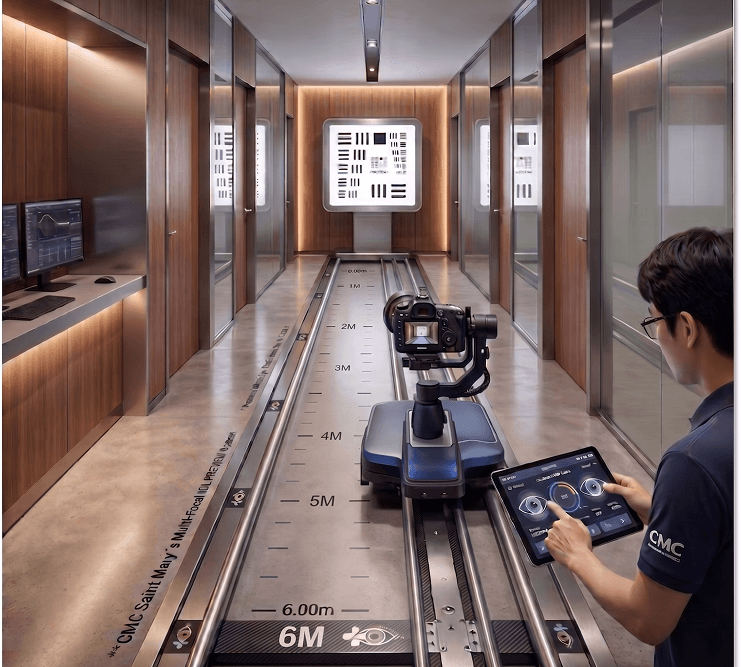
Experimental setup for quantitative analysis. A. A USAF 1951 resolution target was printed on backlit film at 50 × 50 cm and mounted in front of an LED light panel. The model eye approached the target from 6 m to 15 cm while video was recorded. A cinema dolly track was laid on the floor, and the dolly was connected to a smartphone via Bluetooth to approach the target automatically.